Cryptograph
In 2018, Guillaume Gonnaud, Edouard Bessire and Hugo McDonaugh set out to build Cryptograph, a platform selling one-of-a-kind digital works made with artists and public figures, to raise money for charities. It launched in 2020 as the first celebrity NFT platform in the world, at a time when most people had never heard the term NFT. Contributors included Vitalik Buterin, Paris Hilton, Jason Momoa, Adrien Brody, Ashton Kutcher, Matt Bellamy, Alec Monopoly and the estate of Kobe Bryant. Each creation was called a cryptograph and the artwork’s ownership stored as an NFT on the Ethereum blockchain. When collectors bought or resold a cryptograph, it raised money for the cryptograph’s creator and their chosen charity.
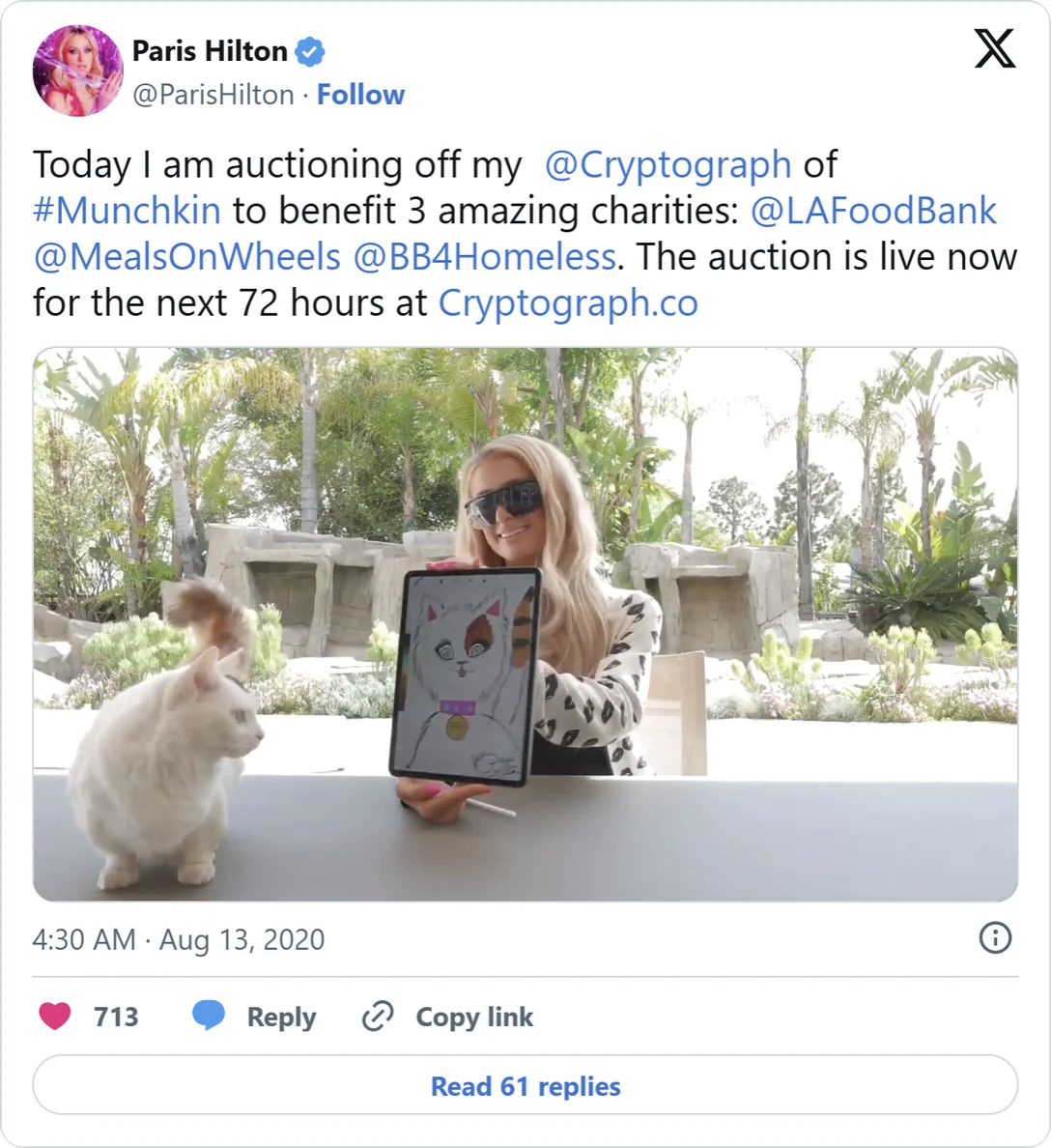
To sell these unique works on the blockchain, the three founders invented a new auction mechanism: GBM. In a conventional auction one bidder wins and the rest leave with nothing; in a GBM auction, a bidder who is outbid receives their money back plus a cash reward, fixed at the moment they bid and paid the instant someone goes above them. They called it Bid-to-Earn. Rewarding outbid bidders incentivises participation — more bidders, earlier bids, better price discovery. Every sale on Cryptograph used it and money was raised for dozens of charitable organisations.
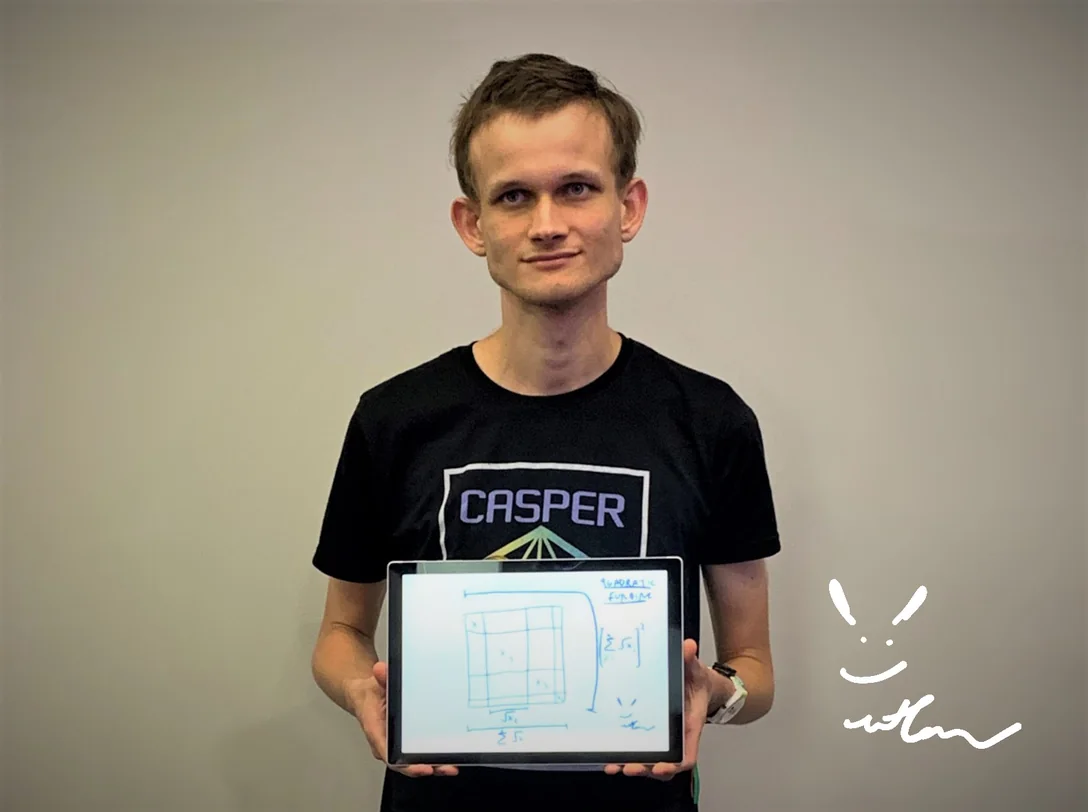
A patent application covering the GBM auction mechanism was filed in 2018 and published as US20210174432A1.
From feature to product
By the end of 2020 the NFT market was heating up, and projects issuing collections of their own ran into the same problem Cryptograph had already solved: how to price NFTs in a fair and transparent manner on the blockchain. The team decided to turn GBM into a solution other crypto projects could use.
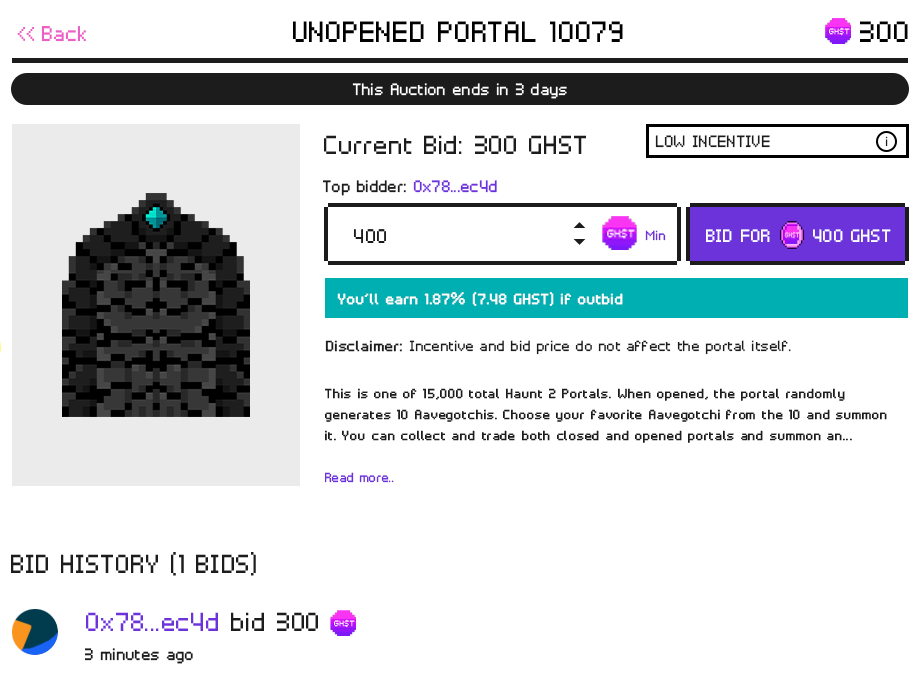
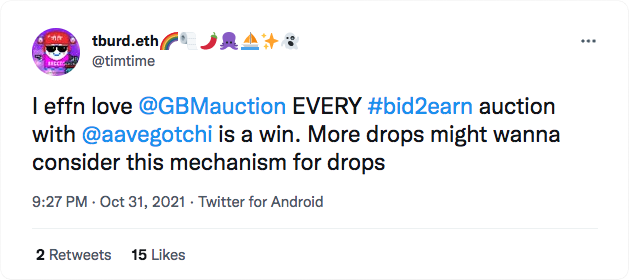
The first substantial adopter was Aavegotchi, one of the most active and successful crypto games at the time. Aavegotchi ran GBM auctions for its own drops on Polygon in 2021, increasing its revenue by 158 per cent and reaching $52M in sales.
myNFT
As the NFT market boomed in 2021 — volumes reached $17B that year — the three founders raised over $7M to build myNFT, a general-purpose NFT marketplace with GBM auctions built in. The round was led by Scytale Ventures, with Signum Growth Capital, Future Perfect Ventures and SevenX Ventures following, alongside a number of business angels.
The ambition was to build the most user-friendly way for anyone to create, share and trade NFTs, aimed at people who were not already in crypto rather than those who were. The team grew to 25, working remotely across 10 countries.
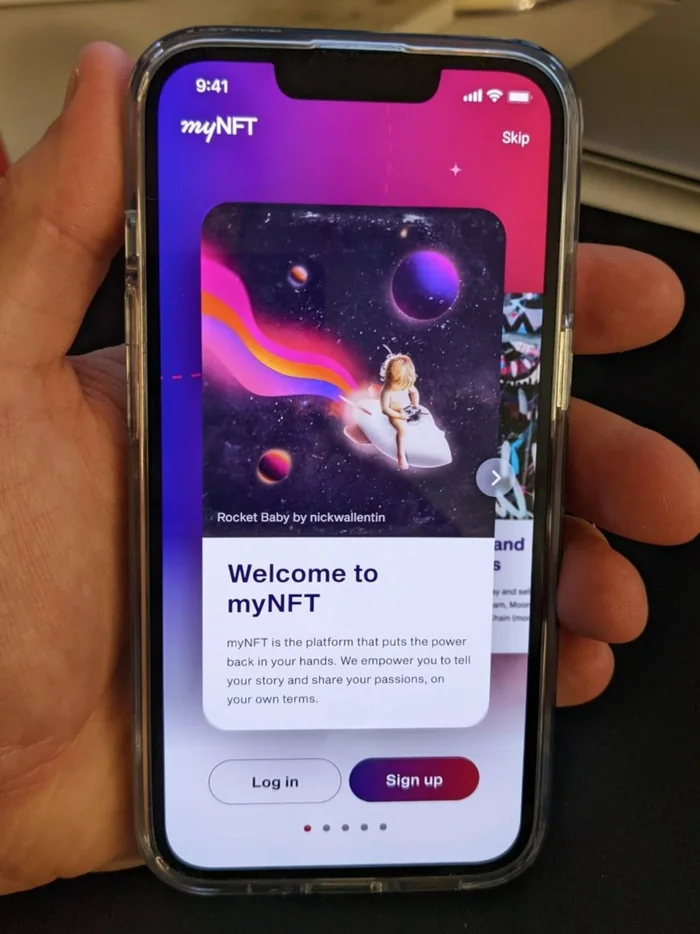
The platform was completed at the end of 2022, by which point trading volumes across the sector had fallen by roughly 90 per cent from their peak. The market never recovered.
A blockchain technology provider
The company decided to shelve the general-purpose marketplace and turn what was built for myNFT — the auction engine, the settlement logic, the interfaces — into a blockchain application put to work on other people’s platforms.
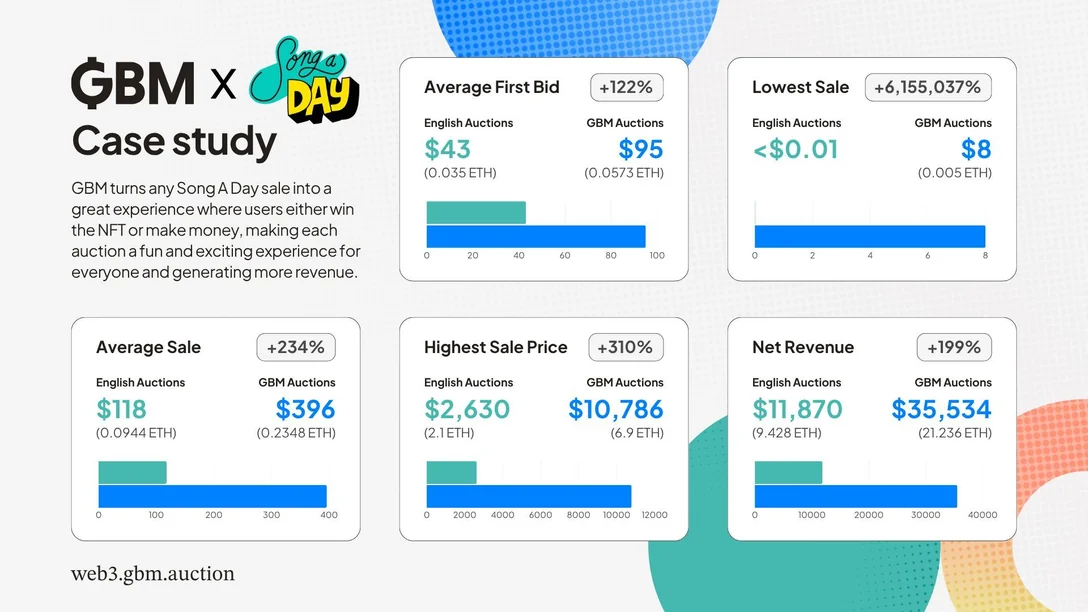
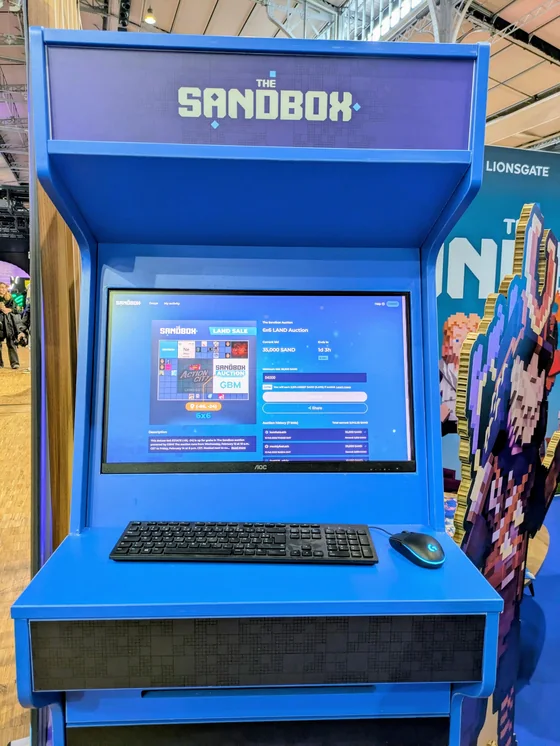
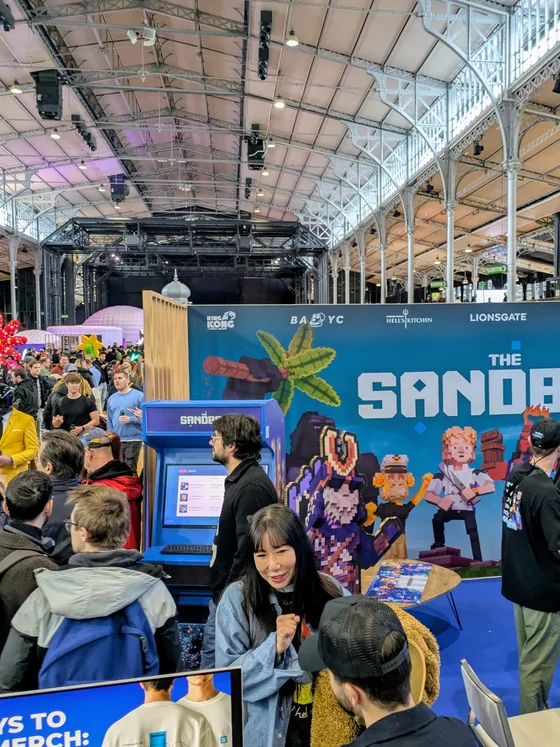
The GBM product was successfully deployed as a white-label solution across seven blockchain networks and integrated by projects including The Sandbox, Decentraland, Unstoppable Domains, Freename, Singular and Song A Day.
Fiat currency product
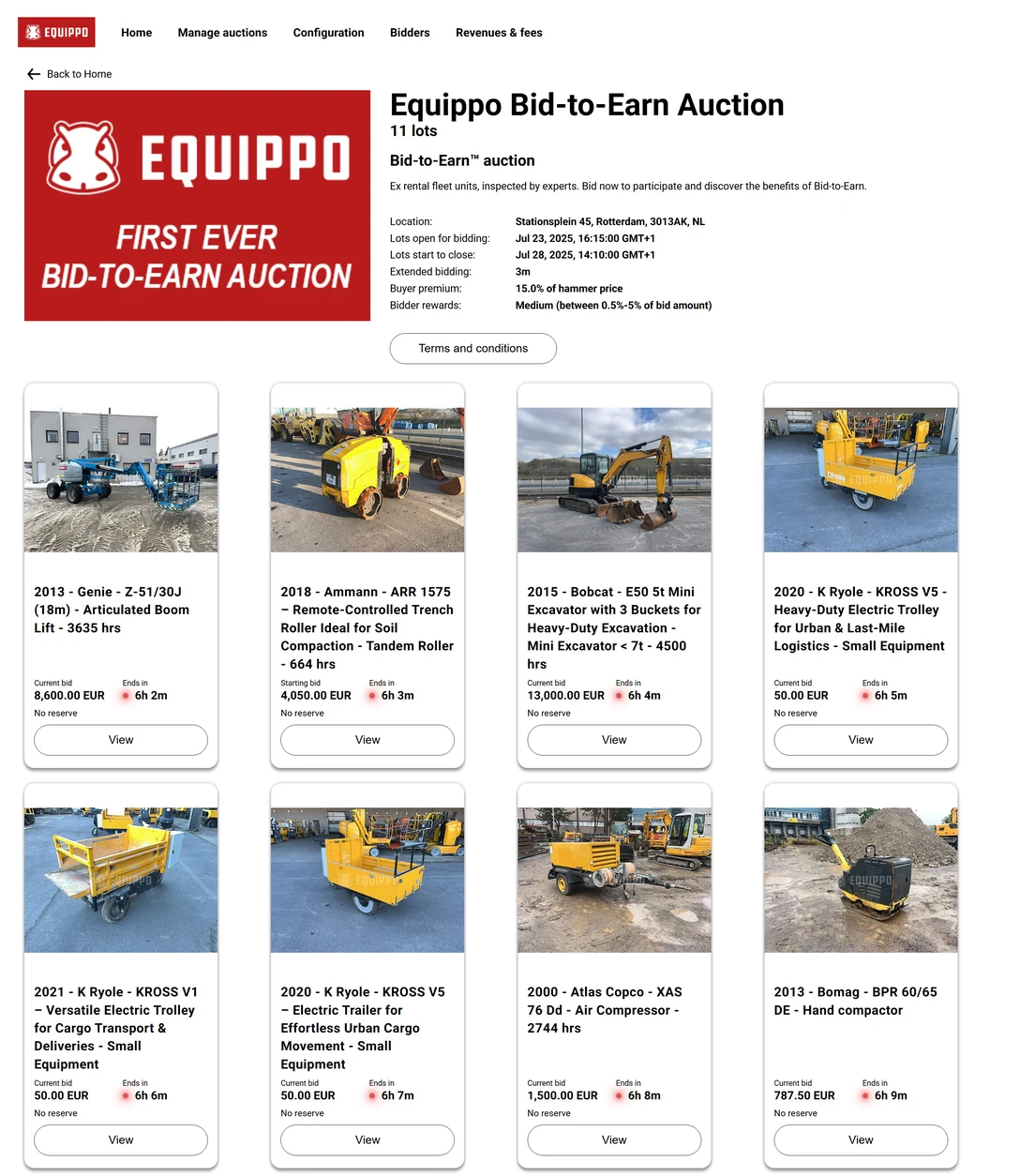
In 2025, alongside the blockchain business, GBM launched a white-label auction platform for traditional auction houses, powered by Stripe. It was the first time the mechanism ran in ordinary currency — dollars, euros, sterling — rather than crypto.
This put the GBM auction within reach of established auction houses and marketplaces outside the crypto market. The product went live across three continents and was used to sell everything from heavy construction equipment to domain names and fine art.
The $GBM Protocol
After years of running the blockchain side as a service business, the team decided it was time to decentralise it and hand it over to the community. GBM was released as an open protocol: any project could deploy its own auction house without a contract, an introduction or a line of code, and a protocol fee was collected by the smart contract at settlement.
The protocol was governed by the $GBM token. It served as the currency for deploying auction houses and for bidding, could be staked for rewards and for enhanced incentive rates, and carried voting power over the protocol’s parameters and its treasury. A billion were issued, and the protocol went live in 2026.
The protocol has since been wound down. The contracts remain available and verified on chain. Read the GBM Diamond contract.
How the GBM auction works
A GBM auction is a timed, open, ascending auction. Bids rise, the highest bidder at the close takes the item, and each new bid has to beat the standing bid by a set minimum, like a traditional English auction.
The difference is what happens when a bidder is outbid. They receive their money back plus a reward, calculated as a percentage of their own bid and fixed the moment they place it. It never depends on the final price, on how many bids follow, or on who wins, so a bidder knows exactly what being outbid will pay them before they commit. The reward rate scales with the size of the bid: the minimum step earns the floor rate, and larger jumps earn more, rising to a ceiling reached at roughly double the standing bid. The money comes from the proceeds of the sale: at the close, the seller receives the winning bid less the sum of every reward paid out along the way.
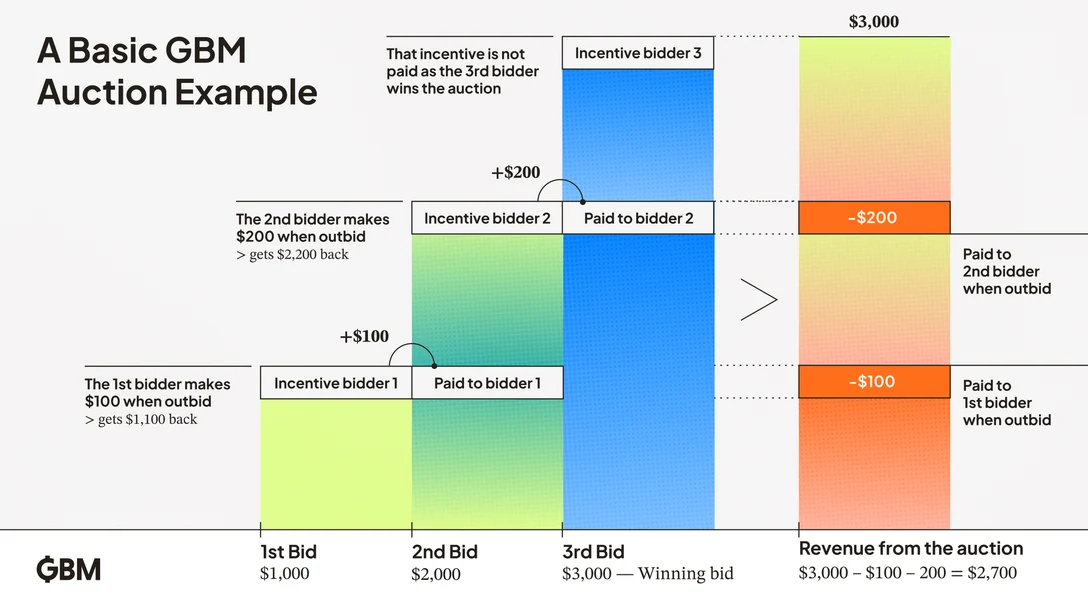
One inequality holds the design together — the minimum bid step has to be at least as large as the maximum reward rate. Rewards are paid out to bidders while the auction is still running, so the money has to be there as it goes, and the inequality guarantees it always is: every new bid adds more to the pot than the reward it triggers. The auction stays liquid at every moment, and the seller’s proceeds never fall however many bids are placed. It also makes gaming unprofitable by construction: outbidding oneself to harvest rewards always costs more in new capital than it returns, which disposes of shill bidding and wash trading at the same time.
A formal analysis of the mechanism was written up and published in March 2026 by Edouard Bessire. The paper derives the equilibrium in closed form and proves the results the design rests on: that every bidder is better off under GBM than under a conventional auction whatever their appetite for risk, that the overbidding it induces is negligible, and that in thin markets the additional participation more than covers the cost of the rewards, leaving the seller ahead as well. It tests those predictions against 11,900 auctions run under controlled conditions.
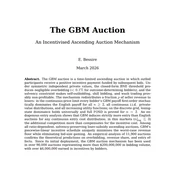 The GBM Auction: An Incentivised Ascending Auction Mechanism
Supplementary Materials
The GBM Auction: An Incentivised Ascending Auction Mechanism
Supplementary Materials
In the press
Cryptograph, 2020–2021
-
 Crypto Luminaries Auction NFT ‘Art’ for Charity
-
 Vitalik Buterin creates digital art on Ethereum platform Cryptograph
-
 Auction of a Vitalik Buterin NFT
-
 Paris Hilton drew a cat and it somehow sold for $17,000 in ETH
-
 Ashton Kutcher burned his artwork — and put it on the blockchain
-
 Ashton Kutcher burns art doodle for charity
-
 Jason Momoa draws his Trident Cryptograph, with proceeds to conservation
-
 Scott Storch and Eve auction digital art on Cryptograph
-
 Muse frontman Matt Bellamy auctions off three unreleased songs as NFTs
-
 Matt Bellamy releases song recorded on Jeff Buckley’s guitar as an NFT
-
 Muse’s Matt Bellamy and Jeff Buckley’s ‘Grace’ guitar
-
Nifty News: Muse frontman drops track as NFT
-
 Kobe Bryant NFT: Mamba Foundation launches ‘Black Mambacita’ on Cryptograph
myNFT, 2022
-
 NFT marketplace myNFT receives Series A funding to revolutionise sector
-
 myNFT to launch fiat-based NFT marketplace after securing $7M in Series A round
-
 myNFT gets ready to launch its game-changing NFT marketplace
-
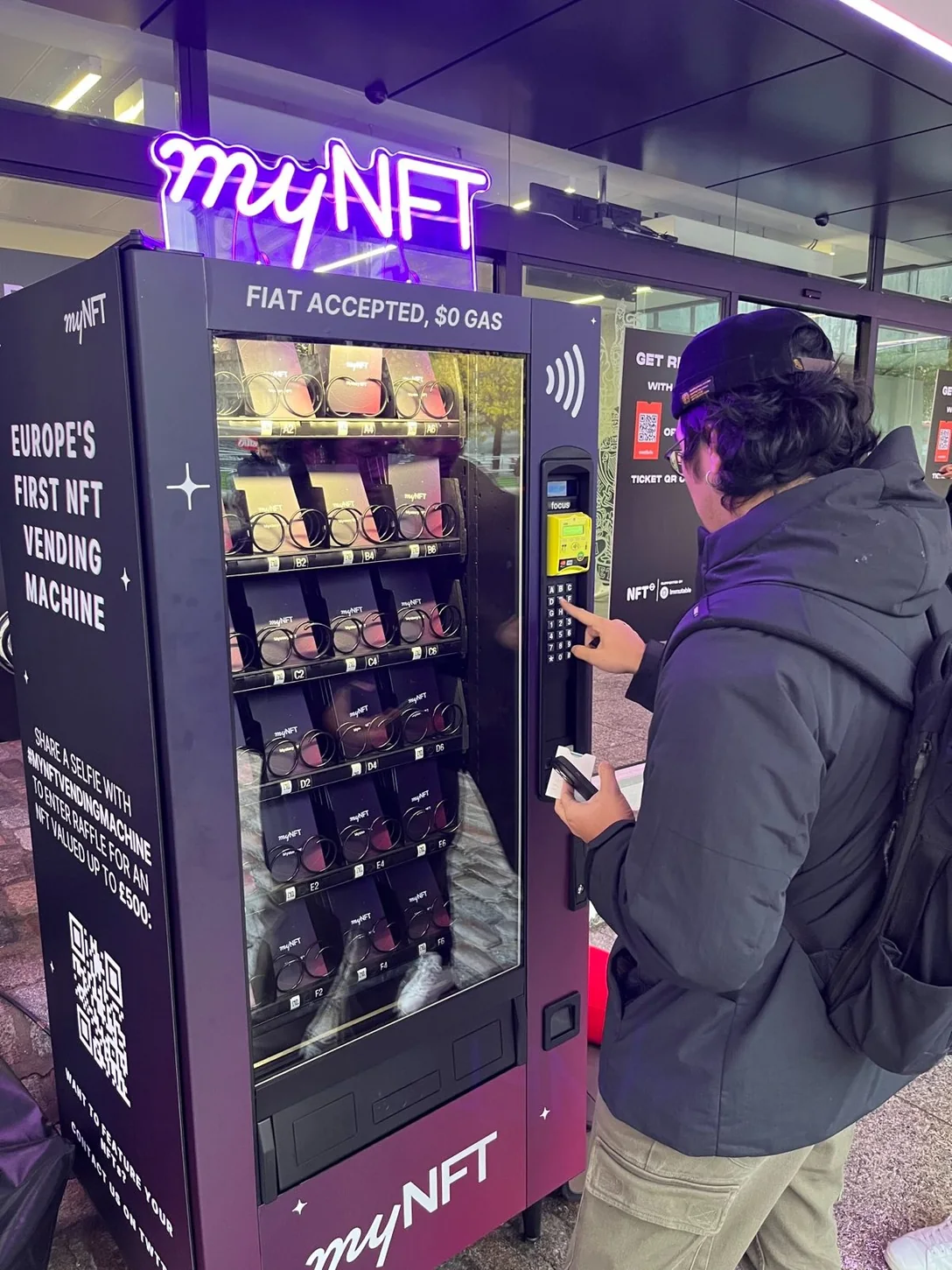
 First NFT vending machine in Europe is coming to London
-
 Europe’s First NFT Vending Machine Gets Cold London Reception
-
Would You Buy an NFT From a Vending Machine?
GBM auctions, 2024–2025


Thank you
Building Cryptograph, myNFT and GBM was an extraordinary run. When we started in 2018, people told us the idea was mad — that we were going to spend our time on pictures on the internet that cannot be copy-pasted.
Crypto in those years was the wild west, and not in the romantic sense. Scams were everywhere, hacks were a weekly event, and trust across the industry was close to zero. The law had not caught up, and banks and payment providers wanted nothing to do with any of it. Then the NFT wave arrived, faster and crazier than we had imagined it could, and receded just as quickly.
Along the way we solved some genuinely hard technical problems, and spent as much effort explaining a technology nobody had heard of as we did building it. We worked with some of the world’s biggest celebrities to raise money for charities. We changed direction several times, learned, and started again. We took a crypto product into the traditional world of payments. Then we gave the blockchain side away as an open protocol. We invented an auction mechanism which sounded too good to be true.
There were plenty of mistakes. It was an incredible education, and we are grateful to have had it.
We worked with remarkable people, and were backed by investors who took a real risk on something that did not yet exist. Thank you to:
- the team members who helped us build this business
- the investors who supported us
- everyone who used our products, and talked about them
- everyone who believed in us
It was quite a ride.